

Dot-separated names
Namespace format
Copy or download result

Dot Case Converter Online

Convert text to dot.case instantly. Paste words, labels, headings, paths, package names, or copied text and create clean dot-separated names for namespaces, structured labels, and technical projects.

Convert to

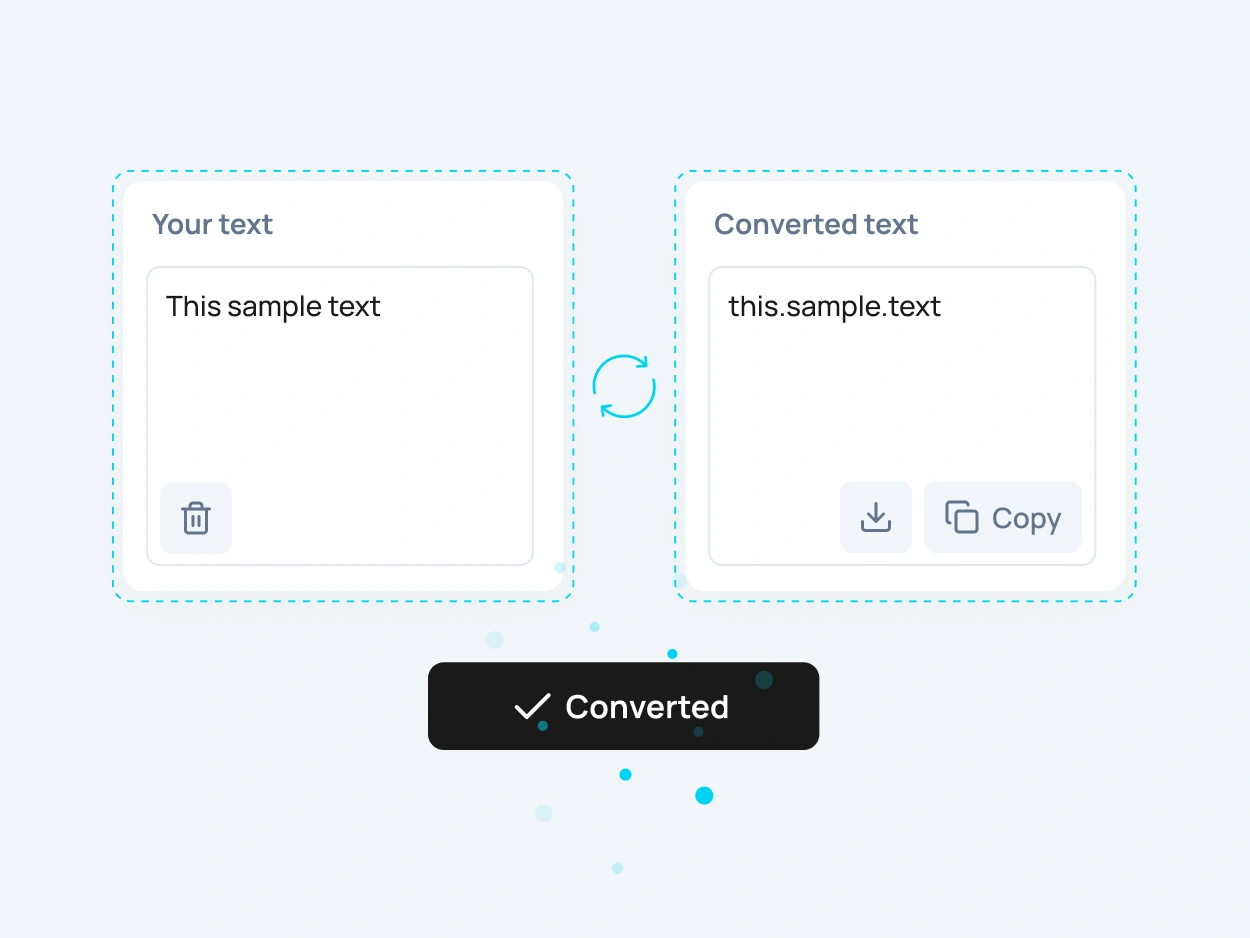
Dot case converter example showing text changed to dot.case formatting

What Is dot.case?

dot.case is a text format where words are written in lowercase and separated with dots. For example, “sample text example” becomes “sample.text.example”.

A dot case converter helps you turn regular text into a clean dot-separated format without editing every word manually. It is useful for namespaces, package names, structured labels, config paths, technical identifiers, and naming systems where dots are used as separators.
When Should You Use dot.case?

dot.case is useful when text needs to show structure, hierarchy, or grouped meaning. It can work well for package names, namespace paths, internal labels, configuration keys, documentation references, file-style identifiers, and technical naming patterns.

You can also use dot-separated text when you want words to stay readable while keeping them compact. Dots can make a name feel more structured than spaces and more hierarchical than underscores or hyphens.

dot.case for Namespaces, Packages
and Structured Labels

Namespace Names

Use dot.case for namespace-style names when you want to show a clear hierarchy between words or sections. This can be useful for technical labels, internal systems, and grouped identifiers.

Package Names

dot.case can work well for package-style naming, module references, library labels, and structured technical names where each word should stay separated but connected.

Config Paths and Keys

Use dot-separated text for config paths, setting groups, feature labels, environment sections, and internal naming systems where dots help show relationships between parts.

Documentation and Labels

dot.case is also useful for documentation references, technical labels, code examples, analytics groups, event categories, and structured text where spaces should be avoided.

Dot Case Converter for Dot-Separated Names

Use this dot case converter to change words, phrases, headings, labels, and copied text into dot.case formatting. It works well for short names, long labels, technical phrases, package-style names, and structured identifiers.

This dot.case converter is helpful when you need to create consistent names before adding text to documentation, code comments, config files, naming systems, package references, namespaces, or internal project labels.

Dot case converter showing text converted to dot.case for namespaces and structured labels

How to Convert Text
to dot.case Online

To convert text to dot.case online, paste your text into the input field, choose the dot.case option, and copy the converted result. The tool removes spaces, normalizes the text, and separates words with dots.

This is useful when you need to create dot-separated names, namespaces, package names, structured labels, config paths, documentation references, or technical identifiers without manually editing every word.

More Case Converter Tools

Need another text format? Explore related case converter tools and choose the best option for your content.

slug-case

slug-case converts text into a clean URL-friendly format with lowercase words separated by hyphens. It is useful for slugs, URLs, filenames, and SEO-friendly page paths.

camelCase

camelCase removes spaces and joins words while keeping the first word lowercase and capitalizing the next words. It is commonly used in JavaScript, variables, functions, and code.

snake_case

snake_case converts text into lowercase words separated by underscores. It is useful for database fields, filenames, variables, API keys, and technical naming.

CONSTANT_CASE

CONSTANT_CASE converts text into uppercase words separated by underscores. It is often used for constants, configuration values, environment variables, and fixed code values.

FAQ

A dot case converter is an online tool that changes regular text into dot.case. It helps you create dot-separated names for namespaces, package names, structured labels, config paths, and technical identifiers.

dot.case is a naming format where words are usually lowercase and separated with dots. For example, “sample package name” becomes “sample.package.name”.

Paste your text into the tool, choose the dot.case format, and copy the converted result. You can convert labels, headings, package names, phrases, and copied text to dot.case in one click.

dot.case is used for dot-separated names that need to look structured and readable. It can be useful for namespaces, package references, config paths, documentation labels, analytics groups, and internal naming systems.

Yes. dot.case works well for namespace-style names because dots can show hierarchy between words or sections. This makes it useful for structured technical labels and grouped identifiers.

No. dot.case separates words with dots, such as sample.text. snake_case separates words with underscores, such as sample_text. Both are naming formats, but they are used in different technical situations.

dot.case uses dots between words, such as sample.text.example. kebab-case uses hyphens, such as sample-text-example, and is more common for URLs, slugs, filenames, and web paths.

Yes. You can use dot.case for package-style names, module labels, internal references, structured identifiers, and technical naming systems where dot separation makes sense.

Yes. dot.case is a structured naming format used to make multi-word names more readable. It is related to broader naming conventions, which describe how names are formed in programming and technical systems.

Yes. The Dot Case converter is free to use online and does not require registration.

Yes. After converting your text, you can copy the dot.case result or download it as a text file for use in your code editor, documentation, CMS, config file, spreadsheet, or technical project.